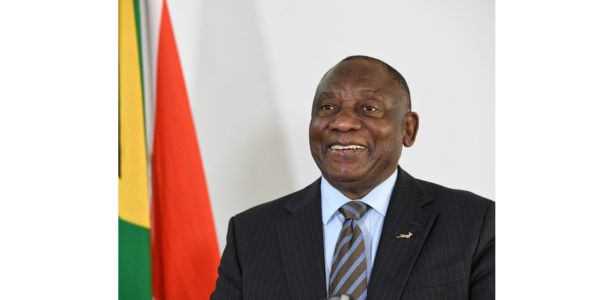
South Africa will develop a national artificial intelligence action plan that must look at better public services, investment and the risk that workers may be affected by new technology.
President Cyril Ramaphosa says the plan must be developed within 90 days after he and a South African delegation met with technology companies, researchers and investors in Silicon Valley in the United States last week.
He said on Monday in his weekly newsletter that the plan will set out immediate priorities to direct South Africa's participation in the rapidly developing world of artificial intelligence (AI). The goal is to transform what the delegation learned during the visit into practical results.
Ramaphosa said on Friday at the end of the visit that South Africa must play an active role in the development of AI and not fall behind as technology transforms the global economy. He wants to set out the key elements of the plan in his State of the Nation address in February.
Four priorities for AI action plan
According to Ramaphosa, the action plan must focus on four immediate priorities.
The first is to use AI to improve public services and government efficiency. He referred to possible uses in education, healthcare, agriculture and government administration.
The second is to make South Africa a competitive destination for investment in AI infrastructure. The third is to develop local AI capability and give universities, researchers, developers and entrepreneurs better access to the technology and the necessary computing resources.
The fourth priority is to prepare the country for the risks and disruption that AI can bring. This includes cybersecurity, the protection of critical infrastructure and training for workers.
A small team led by the Presidency must drive the work. According to Ramaphosa, the team must include experts from government, business and academia and have clear responsibilities, measurable targets and fixed deadlines.
Opportunities and risks for workers
Ramaphosa says AI can help accelerate development in a country struggling with poverty, unemployment, inequality and unequal access to services.
He gave examples of how the technology could possibly be used: to help hospitals with diagnoses, to give farmers information about crop diseases and to process government applications more efficiently.
However, the president also warned that AI can deepen existing inequalities and displace workers, even as it creates new industries and job opportunities. He says workers must be prepared for these changes through education, retraining and lifelong learning.
In his newsletter he said legal and regulatory frameworks must encourage innovation while protecting privacy, intellectual property, human rights and the public interest.
Space for Africa's languages
Ramaphosa also said at a conference in San Jose that South Africa must not merely be a consumer of technology developed elsewhere. The country must develop and own technology itself.
He pointed out that African languages, history and experiences are underrepresented in much of the data on which leading AI systems are based. This may mean that these systems do not serve all people equally well.
According to him there is an opportunity to develop African datasets and strengthen research in African languages, taking into account privacy and the responsible use of personal information.
The delegation to Silicon Valley also included 30 students from universities and technical and vocational training colleges. Ramaphosa says the visit gave young South Africans the opportunity to learn from leading technology companies.
This article is an automatic English translation of a Nuusflits article originally published in Afrikaans. Read the Afrikaans original.