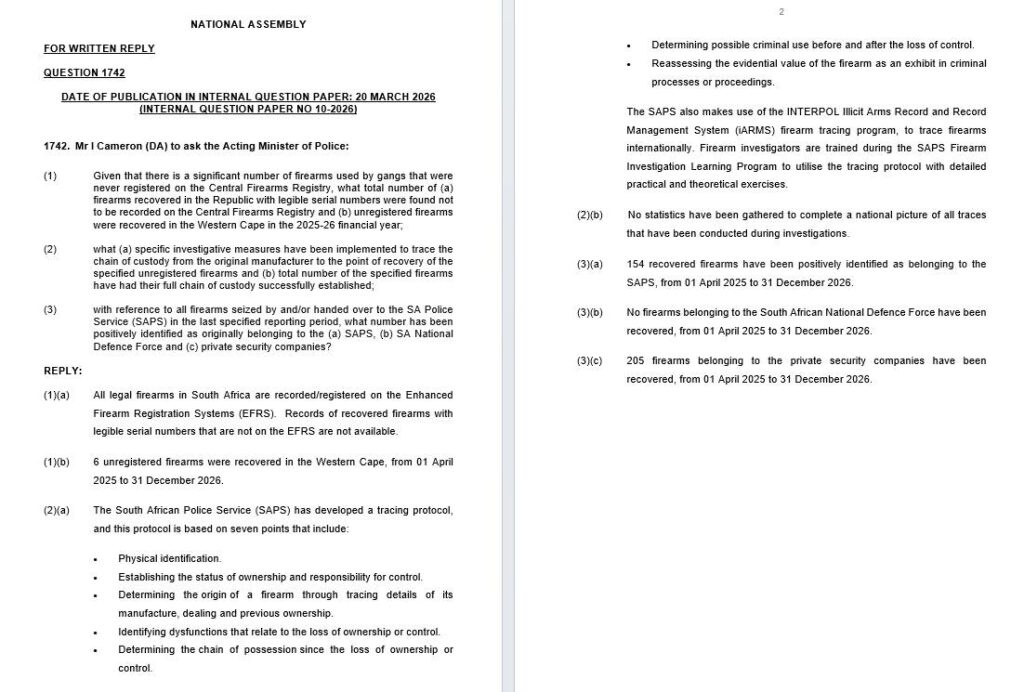
Die polisie kon nie aan die parlement verslag doen oor hoeveel vuurwapens teruggevind is, mét leesbare reeksnommers wat nie op die nasionale vuurwapenstelsel verskyn nie.
Volgens Ian Cameron, voorsitter van die portefeuljekomitee van die polisie en DA-parlementslid, wat die parlementêre vraag gestel het, het die polisie erken dat rekords van teruggevonde vuurwapens met leesbare reeksnommers wat nie op die verbeterde vuurwapenregistrasiestelsel verskyn nie, nie beskikbaar is nie. Hy sê verder dat die polisie ook erken het dat geen statistieke ingesamel is om ‘n nasionale beeld te vorm van alle opsporings wat tydens ondersoeke uitgevoer is nie. Cameron sê vuurwapenopsporing is nie ‘n papierwerk-oefening nie, maar die manier waarop lekkasie-punte, korrupte amptenare, skurkehandelaars en kriminele netwerke geïdentifiseer word. Die parlementêre antwoord bevestig ook dat 154 teruggevonde vuurwapens wat oorspronklik aan die polisie behoort geïdentifiseer is. Syfers wat volgens Cameron elke Suid-Afrikaner bekommerd hoort te maak.
Die DA eis dat die polisie behoorlike nasionale opsporingsstatistieke verskaf.
Lees hier onder wat Cameron sê:
In a parliamentary reply to my question, SAPS confirmed several deeply concerning facts about recovered firearms in South Africa. I asked how many recovered firearms with legible serial numbers were found not to be recorded on the Central Firearms Registry, especially given the number of firearms used by gangs that appear never to have been legally registered. SAPS’s answer was blunt: records of recovered firearms with legible serial numbers that are not on the Enhanced Firearm Registration System are not available.
That is a serious problem. If a firearm is recovered with a legible serial number, but SAPS cannot tell Parliament whether it appears on the national firearms system, then our tracing and intelligence capability is not where it should be. SAPS also stated that only 6 unregistered firearms were recovered in the Western Cape during the reporting period. That figure needs interrogation, particularly in a province where gang violence and firearm-related murders remain a daily reality. More concerning is SAPS’s answer on tracing. SAPS says it has a tracing protocol and uses INTERPOL’s iARMS system to trace firearms internationally. That is positive on paper. But when asked how many firearms had their full chain of custody successfully established, SAPS answered that no statistics have been gathered to complete a national picture of all traces conducted during investigations.
That is the heart of the problem. You cannot claim to be serious about illegal firearms if you cannot measure how many recovered firearms are being traced from manufacturer, to dealer, to lawful owner, to point of loss, theft, diversion or criminal recovery. Firearm tracing is not a paperwork exercise. It is how we identify leakage points, corrupt officials, negligent institutions, trafficking routes, rogue dealers and criminal networks. The reply also confirms that 154 recovered firearms were positively identified as originally belonging to SAPS, and 205 recovered firearms were identified as belonging to private security companies.
That should worry every South African.The debate must be honest. Law-abiding firearm owners are not the central threat. The central threat is the failure to stop firearms leaking from state, institutional and criminal channels into the hands of gangs and violent offenders. SAPS must now correct the reporting period in this reply, provide proper national tracing statistics, and explain what consequence management follows when SAPS-owned or private security firearms end up recovered from criminal circulation. South Africa does not need symbolic attacks on lawful self-defence. We need intelligence-led policing, proper firearms tracing, prosecution-led investigations, and real accountability for every firearm that moves from lawful control into criminal hands.
IC