
Opinion by Therèse Havenga, Head of Business Transformation at Momentum Savings.
Some of the best money lessons are not the newest. Therèse Havenga, Head of Business Transformation at Momentum Savings, sets out six principles she learnt from her parents and grandparents that still hold up against every market trend.
I like to think of myself as fairly modern. I am digitally savvy, I have made friends with artificial intelligence and I even try to keep up with the way the world, and the world of money, keeps changing.
That said, I have to admit there are areas where I prefer the classics. Firstly music, then elegant clothing rather than the latest and the brightest. I watch a classic film like My Fair Lady when I think life is being unfair.
The same is true for money. Apart from staying on top of investment and savings options, new trends and what is happening in the markets, I cling to a couple of money principles I learnt from my parents and grandparents. They may not sound flashy, but they have stood the test of time.
Money does not make you happy
When I was younger I used to roll my eyes when people said money does not make you happy. It sounded like something sentimental adults said when they did not want to talk about reality. Now that I am older and have been through some financial ups and downs, I know better. Yes, if you do not have money your life can be an unbearable nightmare. But money in large amounts is not going to make you proportionally happier. If you cannot be content with little, you will not be content with a lot. My parents taught me to appreciate what we can afford. For that I will be forever thankful. My purse does not determine who I am.
Saving can feel surprisingly good
Years ago I once received R100 from my grandfather. When you are little, such an amount sounds like a fortune. That first biggish amount I could start saving made me feel like a millionaire. It was not just about the money. It was about the possibility. Saving is often presented as a sacrifice, but it can also be deeply empowering. It still inspires me to know that I have something to fall back on and that I am not paying double for short-term gains because I had to buy on credit. Saving gives you options. And options give you breathing room.
Time is your friend
My parents never had a lot of money, but they had a lot of insight. One of those insights was to teach us that it is not about how much you save, but that you save and that you start early. Ironically, small amounts at the beginning of your career will grow much faster than huge amounts at the end of your earning years. People who talk about time in the market are not lying to make you feel better.
If you get a windfall of R50 000, this is how well it will do for you over a period of 10, 20 or 30 years. We assume the money grows at 12% per year and round off the numbers.
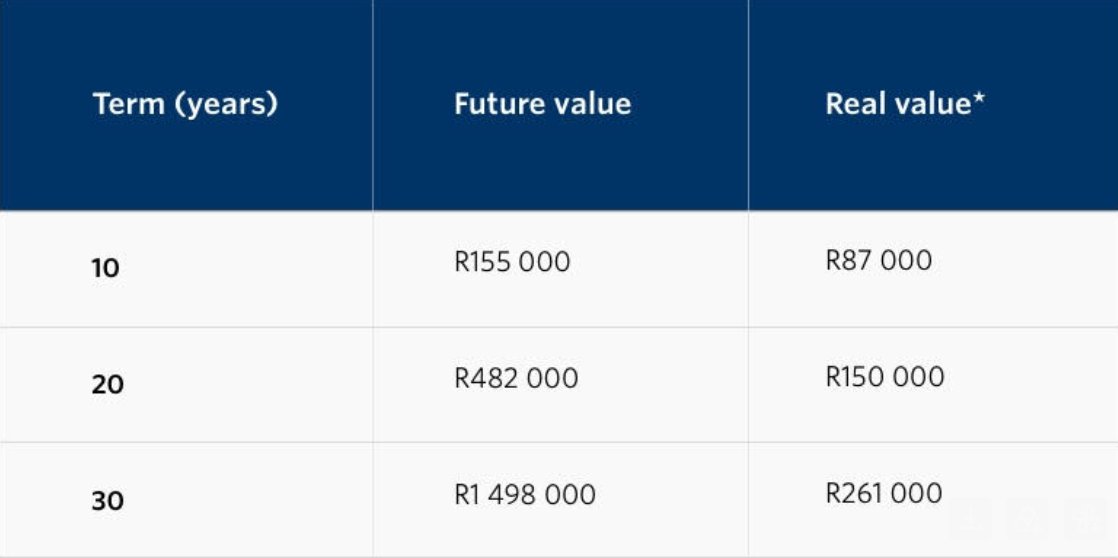
Real value is a way to see how your saved money would look today, even if we look at it years from now.
Know where money really comes from
Fortunately I do not believe in Fortuna, the goddess of luck, fortune and fate. My mother taught me where money comes from. In her case it was working for the university, year in, year out. The Lotto is an illusion. Just read how many people who get a fortune as a windfall lose it just as easily. I am proud that I can work hard and earn a decent salary for my efforts. There is dignity in earning and pride in doing meaningful work. That lesson may not sound glamorous, but it is one of the most grounding money lessons of all.
Credit should be a tool, not a lifestyle
We have probably all done it: chased a credit card for things we wanted so badly. A new dress, a pair of shoes, a holiday. When I do the sums to see how much something on credit costs me, it makes me nauseous. To save upfront for life’s treats makes them so much more enjoyable. But credit is not always bad. Sometimes life happens all at once. The car breaks, the geyser bursts and the timing could not be worse. In those moments access to credit is a blessing. I try to keep credit for two expenses only: paying off my home and my car. And I do not replace my car as soon as it is paid off.
Strive for a realistic goal
I have always admired family members who can set a goal and stick to it. I never knew their secret until I came across the following. Psychologist Catherine Moore investigated goal setting for the website PositivePsychology.com and says 90 years of research shows these tips work:
- Motivation experts agree that goals should be written down.
- Carefully outlined goals, which can be measured and set within specific timeframes, are more effective.
- Explaining your goals to someone close to you or making the commitment public substantially increases your chances of reaching your goal.
I know what I will be sharing with my daughter soon. Do not just hope your money life will improve. Name the goal. Write it down. Give it a deadline. Then take the first small step.
Why these money lessons still work
Many of the best money lessons are not complicated. And sometimes the old wisdom is still the best place to start.