

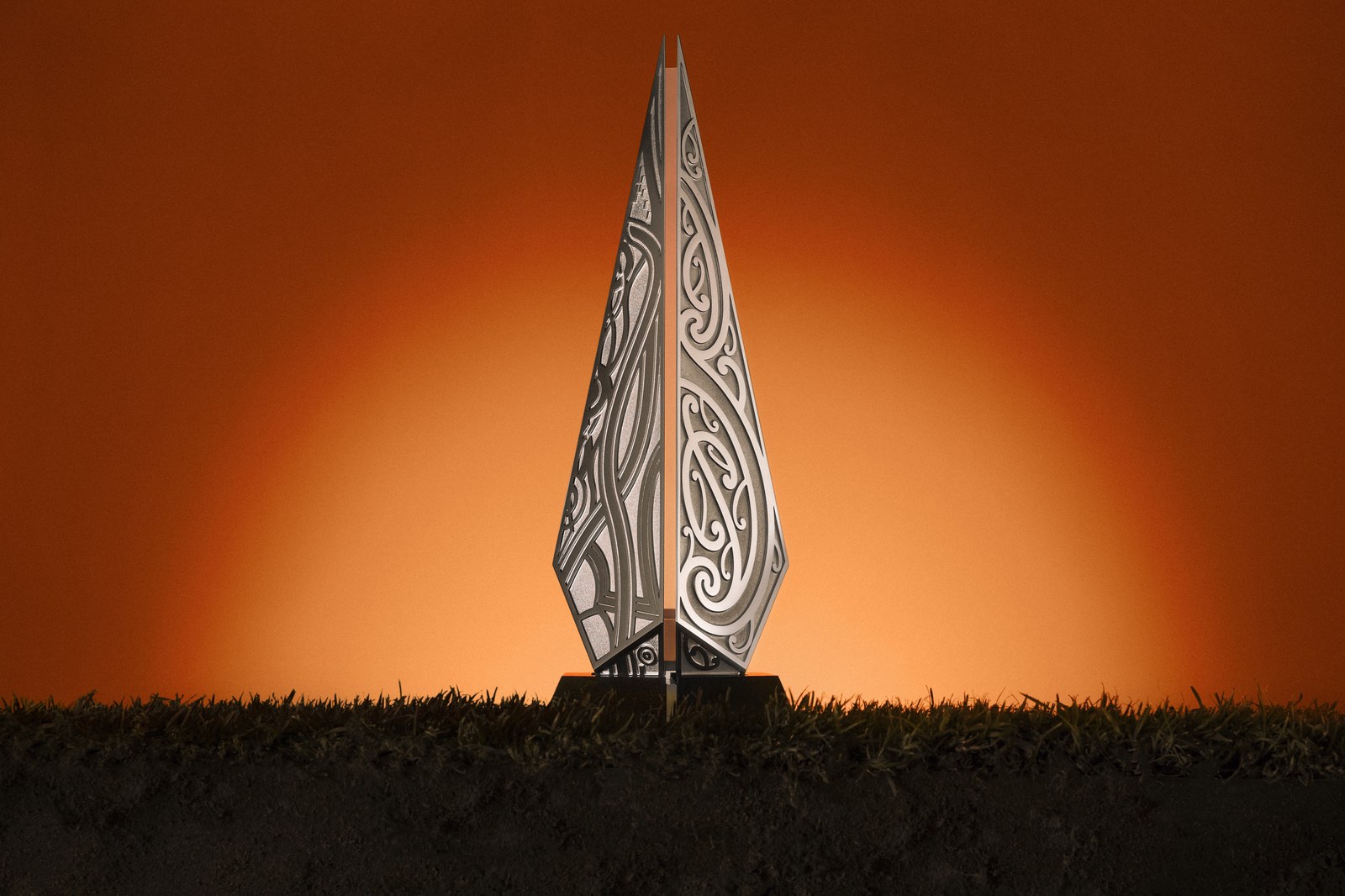
JOHANNESBURG. – The Rugby’s Greatest Rivalry trophy was unveiled in Johannesburg on Wednesday as a world first, created in two halves and drawn together by magnetism to capture the bond between the Springboks and All Blacks.
Read more: Springboks vs All Blacks: Erasmus squad steps up RGR preparations
How the Rugby’s Greatest Rivalry trophy splits in two
The concept was developed exclusively for the revival of rugby tours between the two nations. The winners of the four-test tour will receive both halves following the final test in Baltimore, USA, on 12 September 2026. Should the series be drawn, each nation will retain one half of the trophy.
The trophy was publicly brought together for the first time by the captains of the 1996 series, Gary Teichmann of the Springboks and Sean Fitzpatrick of the All Blacks, at an official unveiling in Johannesburg.
“The brief to the agencies was to create a trophy that was really like no other, and one to capture the essence of the rivalry,” said Rian Oberholzer, CEO of SA Rugby.
“The thinking included the idea that the trophy could be split in two to represent the two halves of the rivalry or that each nation could keep one half if the series was shared.
“This is the eighth time in 12 tours that the series has included four Tests, and if each team has won two tests at the end of 320 minutes of intense rugby, it seemed inappropriate to decide a winner on an arbitrary metric.”
The first two tours between the teams, in 1921 and 1928, were shared.
Two blades, two artists, two nations
The trophy’s shape is inspired by a blade of grass and was developed by Strategy Creative of New Zealand alongside both unions. It is formed from two individual blades, one representing South Africa and one representing New Zealand. Each blade stands independently and only when the two pieces come together does the complete trophy emerge.
Hidden magnets draw the blades together. Each blade has been precision-machined from solid aluminium and features artwork from South African and New Zealand artists.
The South African blade features artwork by Bonolo Chepape, whose work explores the idea that greatness is never achieved alone. The New Zealand blade carries artwork by Kereama Taepa, inspired by the Maori creation story of Tane and Whiro, two brothers whose rivalry sees them pursue the same goal by different paths.
The base continues the theme of two halves making a greater whole. It is made of two distinct stones: black Pakohe stone from Aotearoa New Zealand and green Verdite from South Africa.
Steve Lancaster, CEO of New Zealand Rugby, said the trophy tells the story of two teams and two countries that have been competing against each other for more than 100 years.
“There’s a real respect between the two sides, but also that desire to get one over each other and find a way to win,” he said.
“And if the series is drawn, the fact the trophy can be shared is something special to this tour and this concept.”
When the Rugby’s Greatest Rivalry trophy goes on public display
The trophy will be seen by the general public for the first time on Saturday when the Springboks meet the All Blacks in the first test at 10bet Ellis Park in Johannesburg.
Castle Double Malt, presenting partner of Rugby’s Greatest Rivalry, has backed the return of the traditional tour format.
“What makes this rivalry extraordinary is that neither side loses its identity,” said Vaughan Croeser, Vice President of Marketing at South African Breweries. “It is the coming together of two incredibly proud rugby cultures that creates something the world wants to watch.”
Trophy specifications
- Height: 65cm
- Blade weight: 7kg each half
- Base weight: 9,5kg
- Development and build time: one year
* Press release.