
OUDTSHOORN / SPRINGS. – The death of two young boys within days has drawn attention to meningitis, a disease that in certain cases can develop rapidly and be life-threatening. Aidan Westraad (8), a Grade 2 pupil at Laurus Primary School in Oudtshoorn, died on Sunday 1 November. Frans van den Bergh, better known as Fransie, a Grade 7 pupil at Christiaan Beyers Primary School in Springs, Gauteng, died on Wednesday 4 November after being treated in hospital for a serious infection. Although meningitis has been mentioned in both cases, there is no confirmation that the boys had the same type of infection or that the deaths are related to the disease.
Laurus Primary School paid tribute to Aidan, who is remembered as one of the school's beloved pupils. The school describes him as a friendly boy with a lovely smile and pleasant nature. A memorial corner has been set up in the entrance hall of the school office in his memory. The school also thanked Wesbank Primary School for the flowers sent as a gesture of sympathy. Aidan's family, classmates and all who loved him are in the school community's thoughts and prayers.
Christiaan Beyers Primary School in Casseldale, Springs, paid tribute to Fransie. The school asked the school community on social media several days before his death to pray for his recovery and healing. In a later tribute, the school confirmed he was a Grade 7 pupil and remembered him for his smile and love of rugby. The school extended its condolences to his family and friends, and said he will always be part of the Chrissie family.
Saint Helens Vultures of Springs paid further tribute to Fransie. The team announced that the upcoming match against the Naka Bulls would be dedicated to him. Players will wear red armbands on their left arms as a sign of tribute to the young rugby player and in remembrance of his courage and struggle. The club also expressed its sympathy to Fransie's family. In a separate message, Springs Rugby Club said Fransie held a special place in his teammates' hearts.
According to the Oudtshoorn Courant Nadia Ferreira, spokesperson for the Western Cape Department of Health, said no other cases of meningitis have been reported in Oudtshoorn. The department has traced people who had close contact with Aidan so that appropriate preventive treatment could be given.
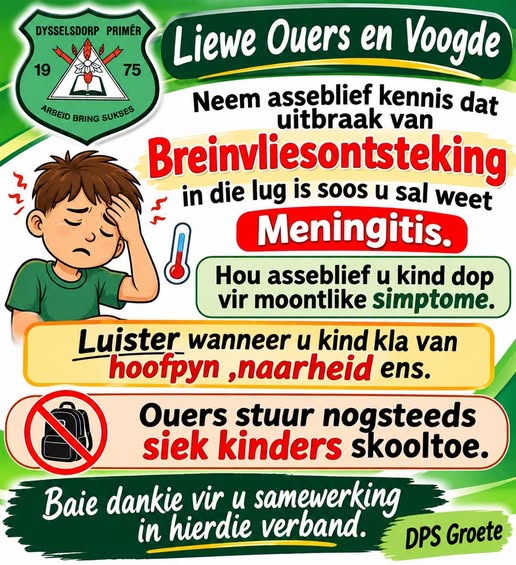
Meanwhile, Dysseldorp Primary has asked parents to watch for symptoms.
The two deaths underscore why it is important that parents and carers know the warning signs of meningitis. The disease can affect people of any age, but babies, young children, teenagers and young adults are among the groups requiring special attention.
What is meningitis?
Meningitis is an inflammation of the protective membranes that surround the brain and spinal cord. According to the National Institute for Communicable Diseases (NICD), it can be caused by bacteria and viruses. Certain other infections, injuries, cancer and medication can also cause inflammation of the meninges.
The cause is important because the different forms of meningitis are not treated the same way. Bacterial meningitis can be particularly serious and requires urgent medical treatment. Viral meningitis is often less serious, while fungal meningitis is less common and can especially affect people with weakened immune systems.
The different forms
Bacterial meningitis is caused by bacteria. Known bacteria that can cause it include meningococci, pneumococci and Haemophilus influenzae type b (Hib). Meningococci can also cause serious bloodstream infection, which can lead to blood poisoning (sepsis). This form can deteriorate rapidly and must be treated as a medical emergency.
Viral meningitis is caused by viruses. It is often less serious than the bacterial form and many people recover with supportive treatment. Antibiotics do not work against viruses.
Fungal meningitis occurs less frequently. It can affect people with weakened immune systems, among others, and requires specific treatment with antifungal medication. Not all forms of meningitis are contagious; the cause determines whether and how it can spread between people.
How does it spread?
The way meningitis spreads depends on the organism that causes it. Meningococci can spread through respiratory droplets and throat secretions, especially when people are in close contact for long periods. This can happen, for example, between people who live together or through intimate contact such as kissing.
This does not mean that everyone who was in the same school, class or environment as an infected person will necessarily contract the disease. Health authorities determine who is considered a close contact and whether preventive antibiotics are needed.
Some viruses that cause meningitis can spread through coughing and sneezing, contaminated hands or contact with contaminated surfaces. Good hand hygiene therefore remains important.
Warning signs for parents to watch
Symptoms can start suddenly and worsen rapidly. The common warning signs are:
- Sudden fever.
- Severe headache.
- A stiff or painful neck.
- Nausea and vomiting.
- Sensitivity to light.
- Confusion or a change in consciousness.
- Unusual sleepiness or difficulty staying awake.
- Convulsions.
- Cold hands and feet.
- A dark red or purple rash that can look like small discolourations on the skin.
A rash does not necessarily appear in every case. Parents should therefore not wait for a rash to appear before seeking medical help.
In babies, the signs can look different. A baby may feed poorly, be unusually irritable, appear lethargic, be difficult to wake or make a persistent, unusual crying sound. A bulging soft spot on the head can also be a sign.
If a child or adult suddenly develops fever along with severe headache, a stiff neck, confusion or other possible signs of meningitis, medical help must be sought urgently. Do not wait to see if the symptoms disappear on their own.
Can it be prevented?
Vaccination offers protection against certain bacteria that can cause meningitis, including pneumococci and Hib. Vaccines against meningococci are available, but protection depends on the type of vaccine and the bacterial group it targets. No single vaccine protects against all forms of meningitis.
Parents can consult their doctor about available vaccines and whether their child's vaccinations are up to date. Information from the NICD indicates that meningococcal vaccination is not part of South Africa's routine childhood immunisation programme.
Regular hand washing, good respiratory hygiene and avoiding sharing drinking cups, eating utensils and toothbrushes can also help limit the spread of certain germs.
People who have had close contact with someone with confirmed meningococcal disease may need preventive antibiotics. This must be determined and arranged by health workers; people should not start using antibiotics on their own.
It is a medical emergency
The World Health Organisation (WHO) warns that bacterial meningitis is a serious disease. About one in every six people who contract this form dies, while about one in every five survivors can have serious long-term consequences. These can include hearing loss, seizures and problems with sight, speech, memory or movement.
The most important message to parents is to take the warning signs seriously and not delay seeking medical help. Rapid recognition and treatment can make a big difference.



Sources: National Institute for Communicable Diseases (NICD), World Health Organisation (WHO), Oudtshoorn Courant, Laurus Primary School, Saint Helens Vultures of Springs, Springs Rugby Club
This article is an automatic English translation of a Nuusflits article originally published in Afrikaans. Read the Afrikaans original.